
posted on Jan 15, 2026 by Andy Efstathiou
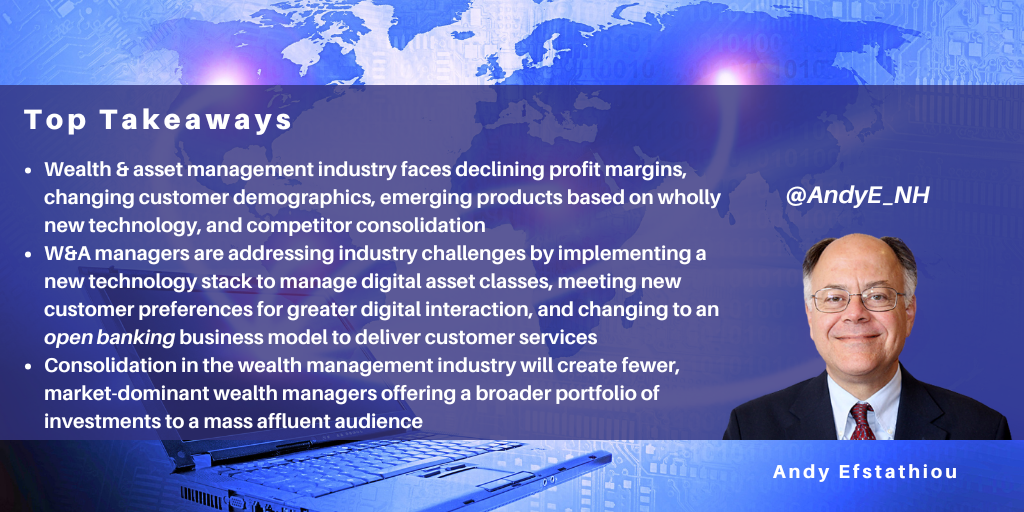
The wealth and asset management industry has been growing rapidly over the past decade, fueled by rising asset values (accounting for two-thirds of the growth), growth in the number of high-net-worth individuals worldwide, and accelerating generational wealth transfer. The largest wealth management market is in the U.S., accounting for ~$105 trillion in assets under management (AUM), three-quarters of the global ~$135 trillion in AUM. Financial analysts forecast that the wealth management industry will continue to grow over the next five years, reaching ~ $200 trillion in AUM by 2030.
Industry challenges
The wealth management industry in the U.S. is structured very differently from the asset management industry. The wealth industry is highly fragmented, with ~326k financial advisors in the U.S. The wealth management industry has been consolidating rapidly in the 2020s, with a current run rate of ~200 M&A deals a year, per Morgan Stanley. In contrast, the asset management industry is highly concentrated, with a few large firms (e.g., Blackstone, BlackRock, State Street Global Advisors) and little consolidation beyond limited acquisitions of specialty asset managers.
Despite the growth in AUM, the industry is facing challenges:
- Declining margins: established parts of the investment business are facing declining pricing, such as investment funds (declining management fees as more investors move into index funds), custody fees (especially in mature asset classes), and shifting business mix (increasing shift from advisor-directed to self-directed. Margins are stronger in emerging asset classes and markets
- Changing demographics: the aging baby boomer population is passing wealth onto a younger generation with different goals and preferred methods of interaction. Successfully attracting and retaining this generation will require large investments in technology to meet customers’ preferences. In addition, new technologies enable cost-effective delivery to a mass affluent audience, which was previously unaffordable to service
- Emerging asset classes and broader distribution of assets to new customers: digital assets (e.g., crypto, tokenized assets, sustainable investments, and structured products) are emerging. These give investment advisors the opportunity to offer assets with different entry points (lower cost for less affluent investors) and different risk/reward characteristics
- Advisor consolidation: wealth advisors with traditional business models are consolidating to reduce their cost of delivery and access new investments and customer bases. The challenge is successfully integrating these businesses into the buying firm’s business culture and technology stack. A successful merger requires large upfront capital, a proven integration framework, and very rapid execution. Currently, peer acquisition is the dominant strategy. The industry is moving towards more cross-sector deals (e.g., between asset managers and wealth managers).
Addressing the challenges
To address these challenges, W&A managers are:
- Extending the range of investment products and services they are offering customers. The focus to date is on private assets, but it is rapidly expanding to digital assets and purpose-driven assets (e.g., ESG assets)
- Expanding customer segments served. To date, investment advisors have focused on retaining customers after inheritance, with poor results. Increasingly, advisors are treating an heir as a cold-call pursuit, requiring them to perform due diligence on the client’s preferences. Targeting new customer demographics requires new marketing campaigns. Often, a separate organization is required to pursue a different marketing approach. Many organizations are working with independent RIAs on a franchise basis to pursue new demographics
- Driving the use of technology-delivered services. Reduced pricing and increased selling to a mass audience require a lower cost structure. Investment managers are moving away from a craft business model to a standardized, factory model. To achieve this operating model, everything must be digitalized. Once digitalized, AI can be applied to understand customer needs, standardize service delivery, and support humans-in-the-loop with complex analytics.
These operational initiatives will drive greater transparency to all stakeholders in the investment industry. Firms that deliver disciplined execution of technology transformation will rapidly grow their businesses as the industry aggressively consolidates.
This is just a sample of what investment managers are doing to prepare for the anticipated growth in wealth and asset management services. I am starting a global market assessment of operations and technology services in the wealth and asset management industry this month. The “Transforming Wealth and Asset Management Services” project will delve deeper into how these initiatives are developing, how wealth and asset managers are addressing challenges, and how technology services vendors are supporting their clients. The transformation promises to change the underlying wealth and asset management business model across many geographies, making home and asset ownership accessible to new consumer demographics under more favorable terms than before. Technology vendors with relevant offerings can contact me directly to participate in this study.