
posted on Jan 07, 2026 by Andy Efstathiou
The financial sector is facing slowing global economies, declining interest rates, rising unemployment, persistent inflation, and growing armed conflict. Despite these headwinds, stock markets continue to rise, and loan default rates remain low. We anticipate the global economy will eventually break to the downside, accelerating change in how financial services operations are delivered. The need to reduce costs will accelerate the adoption of AI and automation, as well as the introduction of new financial products that better reflect customer needs in a new, more austere economic environment.
With this as a backdrop, here are three predictions for the banking industry in the year ahead.
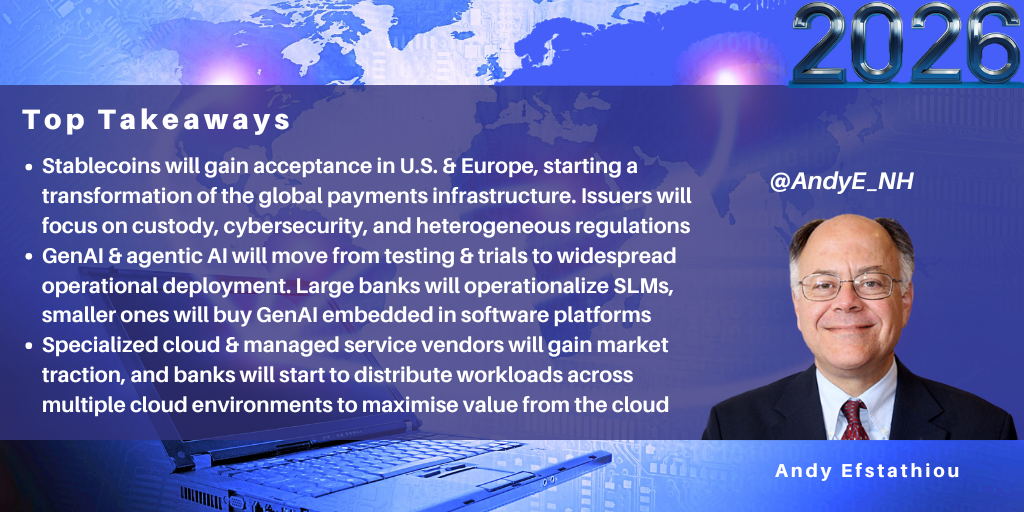
Prediction 1: Stablecoins will start gaining acceptance and transform the payments infrastructure
Stablecoins offer advantages over traditional payment systems, including lower costs, faster settlement, easier global access, and 24-hour access. The U.S. passed enabling legislation (the GENIUS Act, passed in July 2025) to encourage the buildout of the stablecoin industry. The U.S. government will keep supporting stablecoins because the collateral used to backstop a stablecoin’s value is primarily U.S. treasuries. In 2025, U.S. legislation spurred custodians and would-be stablecoin issuers to raise capital and invest in startup activities.
The payments industry is undergoing a restructuring as new technologies (e.g., digital wallets, DLT, mobile payments) and new competitors are changing the services available to customers. Today, many startups in the U.S. are trying to establish stablecoin offerings. Recently, most activity has focused on establishing the infrastructure needed to deliver stablecoin services. Primarily, custodians have been setting up custody offerings for collateral management, wallets, ETF management, and payment execution.
In 2026, we will see custodians, in partnership with IT services vendors, build:
- Links across many institutions to send/receive DLT payments so that customers can use stablecoins ubiquitously, rather than only in a narrow ecosystem
- Cybersecurity specific to digital assets and DLT environments, to mitigate hacking threats. This cybersecurity architecture will include embedded GenAI and agentic AI to address novel attacks in real-time environments
- Coordination with hyperscalers to work with stablecoin sponsors and integrate with traditional payment providers
- Frameworks and tools to embed smart contracts into stablecoins. Smart contracts will enable stablecoin sponsors to differentiate their offerings and enhance the value of payments.
In 2023, Europe passed MiCA, legislation governing stablecoins. MiCAH has stricter rules than the U.S. legislation. To date, the market for euro-backed stablecoins has doubled since mid-2024. In 2026, market participants and regulators will monitor the effect of different U.S./EU regulations on these two stablecoin markets. To date, stablecoin issuers have responded differently to EU regulations. Circle has committed to the EU market and ensured all its offerings are compliant with MiCAH. In contrast, Tether has decided to provide different offerings in each market.
As vendors choose how to respond to other regulatory regimes, regulators will adjust their regulations, likely in 2027, to maintain and grow stablecoin activity.
Prediction 2: GenAI and agentic AI will gain traction in operational deployments
In 2024, global financial institutions conducted numerous GenAI POCs. In 2025, the same large banks began to focus on operationalizing the most promising use cases at scale. In 2026, large banks will accelerate the operationalization of promising use cases, including:
- Developing SLMs for tightly focused business cases. Domain knowledge is critical to identifying these opportunities. Therefore, large banks and their technology service providers will expand their employee AI training programs to provide a base level of understanding to all employees and higher-level AI skills to higher-level operations LOB workers (typically up to 10% of those workers). Ubiquitous AI training will transform operational delivery and staffing
- Large institutions launching agentic AI programs for 2026. A leading example is BNY Mellon’s Eliza, an agentic AI platform that uses Google Cloud’s Gemini. Eliza has over 100 agents deployed providing transaction validations, fixing software code, analyzing financial statements, and accelerating customer onboarding. In 2026, BNY Mellon will aggressively expand Eliza’s activities, and other banks, especially leading regional banks, will expand their agentic AI programs
- While regional and local banks have not undertaken internal AI programs, large ISVs (such as FIS, Fiserv, and Temenos) have been embedding AI into their cloud-delivered platforms. In 2026, banks will accelerate the use of this functionality to bring the benefits of agentic AI and GenAI into their operating environments.
Prediction 3: Evolving cyberthreats will transform banks' approach to cybersecurity and cloud delivery
Specialized cloud and managed service vendors will gain market traction, and banks will distribute workloads across multiple environments. Instead of selecting a cloud provider for a business workload, banks and enterprises will disaggregate workloads by data (structured, unstructured, image, audio, transaction, reference), processing (high performance, DLT, AI, image, transaction, storage), and connectivity/orchestration.
Banks are focusing on supply chain resilience. Improvements in security techniques, coupled with a layered approach to cybersecurity, mean banks are buying from multiple vendors to build a resilient architecture in a rapidly evolving environment. Emerging cloud providers, such as Digital Ocean, are delivering stripped-down services with simpler pricing models.
The maturation of cybersecurity tools enables these specialized vendors to offer a compelling business value proposition at the same or lower level of risk. As banks adopt services from these emerging vendors, it will reduce the monopoly power and pricing of cloud services by the ‘Big Three’.