
posted on Jan 09, 2026 by Vaibhav Wardhan
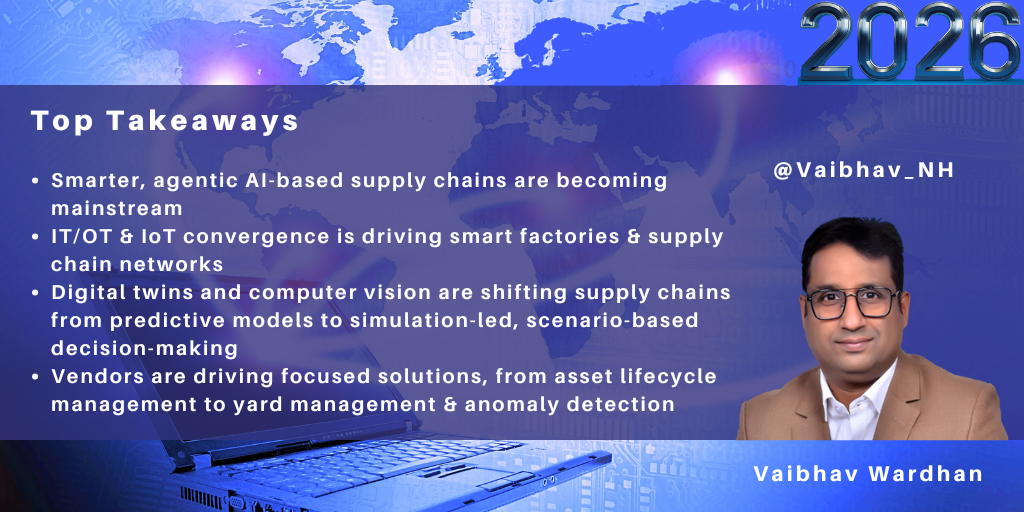
With the help of vendors and partner ecosystems, organizations are re-imagining supply chain operations for predictive intelligence, resilience, and real-time responsiveness. As supply chain leaders continue to overcome siloed systems and focus on systems modernization, real-time visibility, and a predictive supply chain, the seamless integration of enabling technologies becomes vital. Here are five key supply chain trends poised to reshape the industry and redefine vendor offerings in 2026 and beyond.
Autonomous & agentic AI-based supply chains will go beyond POC to become more mainstream
While early AI and ML adoption use cases focused primarily on prediction, forecasting, and recommendations, the next phase of growth is being driven by agentic AI in the supply chain. Enterprise supply chains in the coming years will increasingly rely on intelligent agents that not only analyze data and inputs, but also take autonomous action across planning, logistics, contract management, order management, and cash collections.
GenAI and agentic AI in the supply chain are gaining traction across product development, order management, delivery, and cash collection. Examples include AI-based self-healing master data from Capgemini, automatic shipment optimization, order and stock allocation, demand sensing, and cash collection agents. These agents will enable clients to achieve operational excellence, drive business outcomes, and deliver prescriptive recommendations. Examples include AI-agent managed order and quote management, and agentic AI-based order fulfilment from Infosys.
Smart factories & smart supply chain networks enabled by IT/OT & IoT convergence
The second major trend for 2026 is the acceleration of IT/OT convergence. The integration of enterprise IT platforms such as ERPs, planning, and order management with IT/OT-enabled operational technology is breaking down silos and enabling a real-time view of supply chain performance. This convergence is being amplified by the adoption of IoT across factories, warehouses, equipment, utilities, and logistics assets.
IoT continues to capture a wide array of data, from equipment health and energy usage to temperature, humidity, cross-plant traceability, and material movement. When combined with AI algorithms and agents, this creates an orchestration layer that delivers continuous operational insights and intelligence. Smart factories enabled by IT/OT/IoT integration are moving toward better predictive maintenance and zero-downtime production, more real-time production scheduling, automated root-cause diagnostics, improved energy consumption, and improved quality management.
Capgemini has deployed real-time simulations of manufacturing plants, along with 3D visualizations of plants, warehouses, and transportation networks using digital twins for an automotive client. These simulations are enabling POCs and pilots to be developed and deployed as tools that replicate real-world scenarios, detect anomalies and quality defects, and optimize production. Digital twins will evolve into more reliable decision enablers, providing recommendations based on IoT-enabled data, forecasting shifts and operational constraints that heavily leverage advanced AI and ML algorithms to predict outcomes and simulate scenarios.
Warehousing & logistics automation at scale
Warehousing and logistics have historically relied heavily on manual labor and continue to face labor shortages, manual decision-making, and disconnected systems. Autonomous and semi-autonomous logistics systems, OCR-based number plate recognition, and 3D digital twins continue to make progress and will become standard across mid-market and large enterprises.
Vendor offerings and planning point solutions leverage AI to automate workflows, assign tasks to bots and humans, virtualize physical space to automate logistics and assembly; and IoT-enabled warehouse management systems streamline check-ins, track vehicles, and optimize network and planning. When integrated with WMS and TMS platforms, these capabilities enable operational efficiencies and real-time planning. Not only large, established vendors but also smaller niche players are building their own capabilities and offerings for clients. Examples include:
- Computer vision-based yard management or inventory management offering from Thoucentric
- Computer vision and AI-enabled grading and anomaly detection solution deployed by Wipro for a U.K. based client
- 3D digital twin from Capgemini for manufacturing simulation.
This continuously evolving real-time ecosystem reduces lead times, improves service levels, significantly lowers operational costs, and improves the ESG footprint, a key priority for manufacturers, distributors, and retailers operating in a volatile market.
Predictive, prescriptive, resilient, and connected supply chain
We have seen unprecedented economic turmoil recently, from the pandemic to wars, chip shortages to freight route disruptions, all in the space of five years. This has kept supply chain leaders on their toes, with resilience now a real-time business challenge and a core requirement.
Predictive supply chain risk assessment platforms that analyze geopolitical factors, environmental factors, supplier capacity, and logistics to anticipate disruptions and simulate the impact are not a luxury but an essential part of modern supply chains. IoT-enabled smart factories and smart warehouses that support resilience through predictive detection of anomalies and failures, operational bottlenecks, and quality deviations are becoming mainstream. Real-time deployments and working models are no longer in white papers but are in actual use cases. This shift toward real-time sensing, simulation, predictive insights, and autonomous response capabilities is transforming supply chains into a competitive advantage.
End-to-end value, from product development to order-to-cash
As supply chain enablement and transformation become mainstream, vendors' focus shifts from siloed processes and transactional work, such as order management, to an autonomous, optimized end-to-end supply chain. Clients are increasingly realizing that real value unlocked from the supply chain cannot be recognized in silos, and vendors are also pushing for more end-to-end, unified supply chain operations, from product development to order management, cash collection, and after-sales.
With a connected supply chain, decision-making and predictive supply chain solutions unlock greater efficiency and value, making the supply chain more agile and resilient. For example, InspireXT’s connected supply chain solution helped its client increase online sales by 30% by integrating product information management, inventory, and order management systems, while seamlessly connecting with the POS platform and the legacy SAP environment.
Conclusion
Linear processes, siloed systems, and human dependency will soon be a thing of the past. Instead, an autonomous, connected, predictive, resilient, and orchestrated end-to-end supply chain is the future.
Clients who augment AI, IT/OT convergence, IoT-enabled intelligence, and autonomous execution, and work towards building an ecosystem of in-sourced as well as vendor-managed supply chains, will be able to realize the true potential of an autonomous and connected supply chain. The next era of supply chain transformation is not about doing things better, but about doing them differently, augmenting with next-gen technologies and building an AI-first, native supply chain for 2026 and beyond.