
Search posts by keywords:
Filter posts by author:
Related Reports
Related NEAT Reports
Other blog posts
posted on Jan 12, 2026 by Gaurav Parab
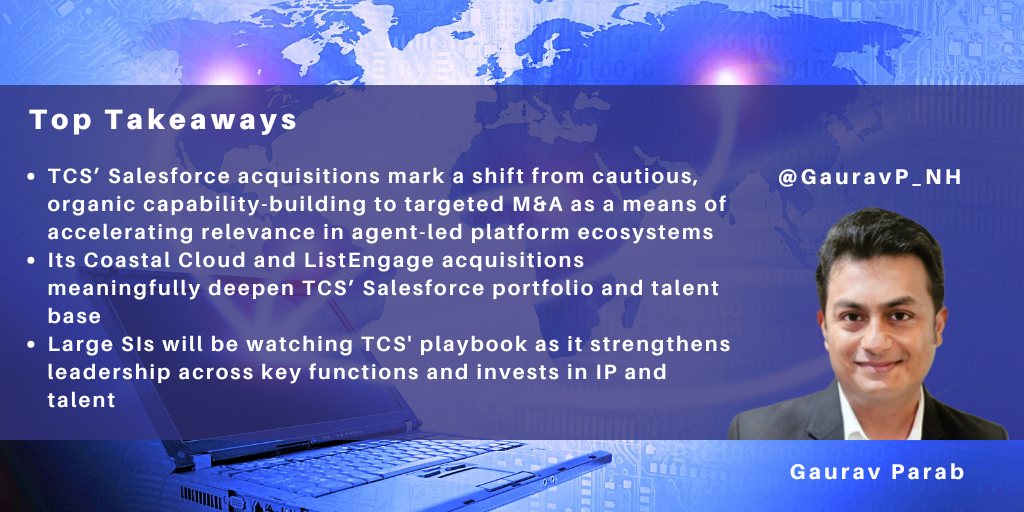
In December 2025, TCS announced a second acquisition (Coastal Cloud) in under two months, with both transactions targeting specialist Salesforce partners. For TCS, which has historically taken a cautious approach to M&A, the pace of recent dealmaking and the focus of these deals are noteworthy. TCS has indicated that, following these acquisitions, it expects to rank among the top five Salesforce service providers globally, signalling a conscious move to strengthen its Salesforce capabilities as a core pillar of its next phase of growth.
These moves offer an opportunity to step back and consider TCS’ evolving priorities. In particular, how do Coastal Cloud (acquired for ~$700m) and ListEngage (acquired for ~$70m) fit into these priorities not only from a Salesforce perspective but also the company’s broader strategy for GenAI and emerging agentic models?
NelsonHall views these developments in the context of broader structural changes that have been underway at TCS in the last 12 months. This includes moves to strengthen leadership across key functions like Strategy, M&A, and AI; the infusion of AI capabilities into its IP portfolio spanning development, QE, and platforms; and a shift towards a more AI-aligned workforce model.
Given TCS’ scale and extensive client footprint, these moves also shape market expectations for other SIs, with clients increasingly factoring AI maturity and execution readiness into recent deal decisions and renewals.
Portfolio, Sector, and Market Synergies
NelsonHall views the acquisition of Coastal Cloud and ListEngage as a response to multiple, convergent shifts within the Salesforce ecosystem and the broader IT services market.
Agentforce Pull
Early reactions to Salesforce Agentforce combined optimism with marketing hyperbole. Fourteen months on, even with recent announcements signalling a revisit of deterministic automation, Salesforce’s shift toward agent-led architectures is substantive and will continue to reshape both the platform and the industry narrative. At TCS’ scale, Salesforce remains one of the few growth vectors large enough to influence performance, making inaction untenable.
At the same time, experienced Salesforce talent remains scarce. While TCS has proven internal training and reskilling programs, the timeframe to establish client stickiness for Agentforce is limited. The acquisitions provide immediate access to an experienced Salesforce talent base, with the next phase hinging on effective integration, particularly on the cultural front. Coastal Cloud (~400) is one of the largest acquisitions in the Salesforce Professional Services space, and with ListEngage’s ~150 practitioners, TCS’ existing practice now ranks among the Top 5 Salesforce partners by scale.
There’s also a smaller but relevant point: both acquisitions strengthen TCS’ onshore presence in North America. In a climate where visa dynamics and location choices continue to shape delivery models, this additional onshore capacity is useful.
Industry and Portfolio Mix
Taken together, the acquisitions strengthen TCS’ Salesforce portfolio by addressing gaps across specializations. Coastal Cloud adds a multi-cloud Salesforce delivery capability with industry coverage and experience across Sales, Service, Revenue, Commerce, and Data Clouds, reinforcing TCS’ existing ability to execute large, enterprise-wide transformations. ListEngage, in contrast, brings focused expertise in Marketing Cloud, Data Cloud, and AI-driven customer engagement, areas where specialist skills and faster time-to-value are increasingly critical. Combined, the two acquisitions improve TCS’ coverage across the Salesforce lifecycle, from core CRM and platform transformation to data-led, agent-enabled CX.
SMB Market
While TCS has been working with SMBs, Coastal Cloud, with its base of around 1.7k mid-sized clients, and ListEngage, which serves roughly 3k smaller enterprises, broaden TCS’ access to segments with which large SIs have traditionally had a lighter footprint. This expanded client mix creates additional growth opportunities beyond Salesforce, particularly as agent-based pricing and consumption models gain wider adoption and also make smaller deals meaningful due to volume and future potential for large SIs.
Salesforce Roadmap
Lastly, an underrated but important detail. Salesforce Ventures backs Coastal Cloud. That alignment gives TCS confidence that Coastal Cloud’s roadmap is closely tied to Salesforce’s own direction. It strengthens TCS’ existing Salesforce portfolio and improves its understanding of Salesforce’s own roadmap.
What it Means for the IT Services Industry
For the wider IT services industry, TCS’ acquisitions underline a shift in how scale vendors are responding to the agentic transition in enterprise platforms. As Salesforce moves from incremental AI features to agent-led architectures, traditional approaches of organic capability building and incremental training may no longer be sufficient, particularly given talent scarcity and compressed timelines.
TCS’ move signals that large SIs are increasingly willing to use targeted M&A to accelerate relevance in high-impact platforms, blending scale with existing industry depth, while continuing their efforts to infuse AI into custom app delivery and services.
This is likely to increase competitive pressure on peers to reassess their Salesforce and broader platform strategies, especially as clients begin to evaluate providers not just on delivery capacity, but on demonstrable readiness for agent-led operating models.