
Search posts by keywords:
Filter posts by author:
Related Reports
Related NEAT Reports
Other blog posts
posted on Jan 13, 2026 by Bilal Chaudhry
Commercial and specialty underwriting continues to face structural challenges that extend beyond incremental automation. Administrative workload remains high, core systems operate in silos, and access to usable data for decision-making is limited. This leads to underwriting teams spending a significant proportion of their time on non-core activities, the decision cycle slowing down even on ‘happy path’ submissions, and efforts to enable scalable, end-to-end underwriting digitalization stalling or failing altogether.
In December 2025, Genpact briefed me, demonstrating its Insurance Policy Suite, and positioning it as a data-centric underwriting platform designed to address these challenges across both the commercial and specialty insurance lifecycle.
Moving Past Task-Level Automation
Current underwriting transformation initiatives are focused on automating specific tasks – document extraction, sanction checks, or workflow routing, to name a few. While these approaches can deliver localized efficiency gains, they fail to improve overall outcomes because decision-making remains fragmented across multiple systems and teams.
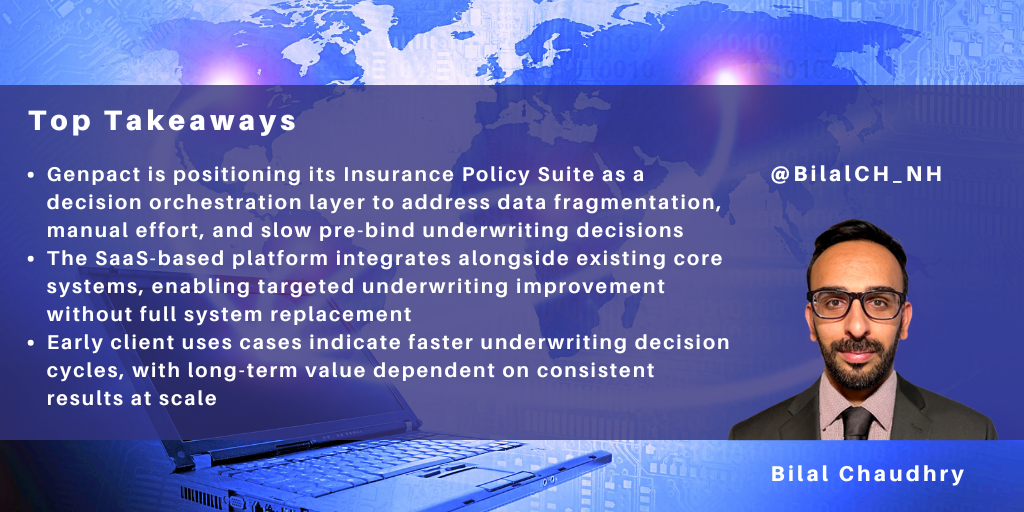
Genpact has a different approach: an emphasis on decision orchestration rather than isolated automation. The Insurance Policy Suite is designed to augment underwriters by coordinating data, analytics, and workflow activities across pre-bind lifecycles rather than replacing human intervention or core underwriting systems.
The Insurance Policy Suite
The suite is delivered as a SaaS platform, and its current focus is on the pre-bind underwriting activities, with post-bind functionality on the roadmap. In addition to commercial and specialty lines, it is also targeted to carriers, brokers, MGAs, and reinsurers rather than personal lines. The platform is structured around four interoperable modules, each of which can be deployed independently depending on client maturity and priorities.
- Submission and Clearance – designed to ingest and qualify incoming submissions from multiple sources (e.g., email, portals, APIs). Its capabilities include AI-based document classification, data extraction across 200 fields, duplicate and sanction checks, compliance validation, and confidence scoring to support STP where needed
- Risk Assessment – focused on contextualizing risk by comparing submissions against historical portfolio data rather than relying solely on individual underwriter experience. Capabilities include holistic risk scoring, guideline validation, fraud detection, and loss prediction bind propensity
- Exposure Management – addressing portfolio-level visibility by integrating internal and third-party data for geocoding, asset valuation, catastrophe modeling, accumulation analysis, and capacity management
- Quote and Bind Accelerator – planned capabilities include integration with pricing and rating engines, quote prioritization, negotiation intelligence, contract and wording generation, issuance support, and automated invoicing and tax calculations.
Incoming submissions are ingested from broker channels, classified, and converted into structured data, with extracted fields displayed alongside confidence scores. Submissions progress through a sequenced workflow covering duplicate detection, sanction checks, and internal validation, with exceptions flagged for human intervention.
The Insurance Policy Suite also provides an underwriter-facing dashboard of portfolio-level metrics, including premiums, loss ratios, renewals, and active transactions. This layer functions as a decision-support layer rather than a system of record, allowing users to drill into underlying data and identify items requiring actions (e.g., upcoming renewals, submission awaiting review). The emphasis is on reducing manual touchpoints while accelerating decision-making and providing underwriting insights.
Genpact describes the Insurance Policy Suite as leveraging an agentic approach, referring to the use of AI components that coordinate how underwriting decisions are prepared, sequenced, and governed rather than executing individual tasks in isolation. Its role is to provide process continuity, ensuring data is appropriately structured, checks are applied, and exceptions are identified and flagged.
From an operational lens, this enables underwriting teams to progress submissions with greater predictability and consistency, while reserving human intervention for scenarios requiring interpretation, negotiation, or risk appetite decision-making within defined guardrails. In the pre-bind process, this reduced reliance on manual coordination supports higher conversion ratios, improves risk selection, and has the potential to strengthen broker and policyholder confidence over time.
Integration with Existing Platforms
The Insurance Policy Suite is designed to operate alongside existing core systems rather than replace them. Genpact positions the platform to integrate with established policy administration, brokers, and risk ecosystems, including Guidewire, Duck Creek, Applied Epic, and other major catastrophe modeling and third-party data providers.
The integration approach is intended to support data reuse across underwriting, pricing, and exposure management workflows, reducing manual re-keying and enabling more consistent decision-making without disrupting incumbent systems. As a result, insurers can selectively introduce the platform within their ecosystem rather than pursue a large-scale system transformation.
Current Observed Impact
Genpact shared multiple clients use cases across submission and clearance, risk assessment, and exposure management modules. Reported impacts include reductions in turnaround time from days to minutes for selected processes, improvement in data consistency, and increased underwriting capacity without proportional headcount growth.
These outcomes indicate the platform’s potential to address high-friction areas within the pre-bind process, particularly where manual coordination and data fragmentation have historically constrained underwriting efficiency.
Outlook
Current client deployments suggest that the Insurance Policy Suite addresses practical underwriting bottlenecks across submission and clearance, risk assessment, and exposure management. Demand is therefore likely to increase among commercial and specialty insurers seeking targeted improvement without undertaking large-scale core system transformation initiatives.
However, longer-term differentiation will depend on Genpact’s ability to sustain measurable value as deployments scale. As orchestration-led and AI-enabled underwriting platforms become more prevalent, differentiation is likely to shift away from architectural concepts and toward demonstrated outcomes, depth of integration, and consistency of results across client environments. Continued investment in functional maturity and outcome transparency will be critical to ensure the Insurance Policy Suite evolves beyond an early-stage proposition into a durable underwriting enablement platform.