
posted on Jan 16, 2026 by John Laherty
NelsonHall recently completed an in-depth analysis of advanced digital workplace services, in which we spoke to multiple leading IT services vendors and their clients. This blog examines key themes from this research, the investments vendors need to make to meet client demand, and the market's evolution over the next 12-18 months.
The four overarching themes from this study were:
- Expanding AI-enabled workplace capabilities
- Experience Management Office (XMO) approach
- Smart workplaces and sustainability
- Expediting digital re-skilling and up-skilling.
AI-first workplace approach
Vendors will continue to expand AI-powered Copilots to provide end-users with intelligent suggestions, automate routine tasks, and deliver real-time insights to improve workflow efficiency. This includes extending Copilot beyond the client’s M365 tenant to third-party systems, such as Workday for HR and ServiceNow for ITSM. Vendors are investing in the overall orchestration of Copilot services through a ‘bot-of-bots’ approach.
There will be a greater focus on custom AI agent development for departments (e.g., HR, IT, finance, marketing), roles (e.g., managers, recruiters, sales agents) and industries (e.g., Healthcare Copilot, Retail Copilot, Manufacturing Copilot, and BFSI Copilot). In addition, there will be increased development of agentic AI suites of agents and agentic workflow orchestration use cases targeting LOBs across the enterprise, as well as local LLMs/SLMs, to address client and industry-specific requirements. Key vendor examples include:
- Wipro has built five custom AI agents in ServiceNow, with 1,525 workflows, including security, HR, IT, operations and procurement agents
- NTT DATA launched Workplace Agentic AI powered by Smart AI Agent, a suite of AI-enabled apps that orchestrate specialized agents to achieve client business outcomes
- TCS invested in Cognix Digital Service Desk, providing an experience-centric, GenAI-enabled service desk with a framework approach to minimize contacts via elimination, self-help, automation, and deflection
- Kyndryl launched an agentic AI framework to enable clients to adopt, deploy, and scale agentic AI solutions. The framework orchestrates and dispatches a portfolio of self-directed, self-learning agents.
Driving holistic experience across the enterprise
Vendors are increasing investment in the XMO-based approach to support experience, encompassing data intelligence, real-time proactive experience management, productivity, XLAs, and sustainability and accessibility capabilities. Enterprises are seeking vendors to baseline XLAs across various industries, allowing them to compare their performance against best-in-class standards. In addition, they are developing a core set of XLAs as well as specific XLAs tailored to certain personas, project-specific XLAs, and outcome-based contracts driven by defined XLAs.
Clients want to leverage DEX platforms and existing tooling investments to drive a connected experience across endpoint management, modern collaboration, and employee digital services. In 2026, we expect to see more focus on developing experience analytics frameworks and XLA dashboards, and on utilizing GenAI and agentic AI to support EX goals. Vendor examples include:
- Unisys is expanding its unified experience management capabilities, including experience of personas (XLA 2.0) and experience of an environment (XLA 3.0)
- TCS is expanding DEX-led experience assurance and dedicated XLAs, and embedding behavioral sciences and workstyle analytics in workspace designs
- Infosys' Orbit employee experience platform is a fully customizable design system with built-in hyper-personalization tools and 100+ accelerators and EX modules ready to go. It also has 25 universal service blueprints, a prototype library, and an API library, including all major EX platforms
- Tech Mahindra has a dedicated XLA office for larger clients, typically with 90k+ end-users, to create, customize, and mature client XLAs through its broader ecosystem, and has a regional joint XLA office for smaller accounts, leveraging shared learning from similar clients.
Increased investment in smart and sustainable workplaces
Vendors will continue to ramp investments in sustainable device lifecycle-as-a-service (SDaaS) and circular computing, as well as quantifying and measuring key metrics to track progress in sustainability reporting. We expect to see more focus on SDaaS on a per-device or per-user basis, with peripherals aligned to the employee’s persona, and on a green refresh predictive model using AI, ML, and predictive analytics; in addition, monitoring device performance and, as it degrades, replacing it with refurbished or remanufactured devices that deliver the same out-of-the-box experience. We expect to see increased traction across industry sectors in the development of smart workplace use cases.
Also, there will be greater utilization of AR/VR/MR and digital twins for remote support and field services, and connecting via Teams to a central command center for guided video resolution. Recent vendor examples include:
- Atos is contracting with clients on dedicated decarbonization level agreements (DLAs)
- NTT DATA is developing a number of smart workplace industry use cases, including manufacturing (Industry 4.0 and autonomous factories), healthcare (providing clinicians with access to patient data on any device), and automotive (enabling visibility into the global supply chain)
- Kyndryl takes a holistic, real-time data approach to maximize positive ESG impact through an iterative approach to sustainable transformation. This includes identifying key sustainability contributors and attributing metrics to the client’s goals and initiatives
- Lenovo’s TruScale DaaS capability consists of a modular stack to offset the carbon footprint of the entire fleet with a one-time cost, track ESG metrics per device per month, and optimize device cost with enterprise-grade refurbished devices.
Ramping upskilling and reskilling initiatives to meet technology needs
We will continue to see both vendors and clients expediting training and upskilling programs to ensure the skill sets are in place to support a future digital workplace. All employees will be required to have at least L1 understanding of GenAI and prompt engineering. In addition, there will be a greater focus on introducing new talent-sourcing models, including gig workers, and increased investment in full-stack engineers and site reliability engineers (SREs) to develop industry and business-specific LLMs/SLMs. Recent vendor examples include:
- Infosys is expanding Infosys Wingspan AI-powered learning platforms to promote continuous learning, including hyper-personalized learning with GenAI learning assistant
- TCS investing in Talent Cloud to drive a location-independent agile workforce and 'universal agent' model. It also has 350k AI-trained resources across the organization
- Capgemini utilizes its GenAI Academy, including onboarding employees to the Copilot interactive learning platform to drive AI upskilling across the company
- DXC’s AI Conversant program mandates 3.5 hours of AI training videos for all development team members. This ensures employees have a solid foundation in AI principles and applications.
Outlook
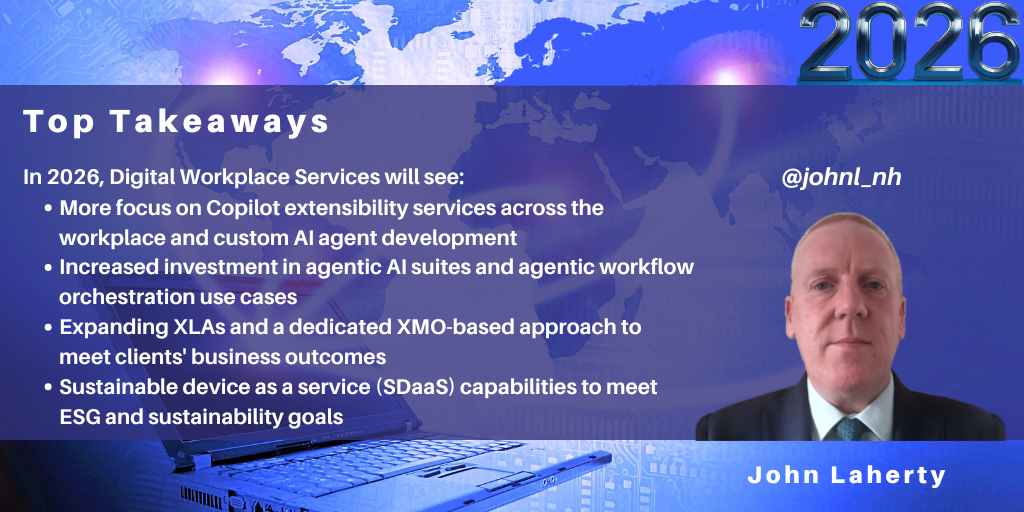
2026 will see a greater focus on developing agentic AI suites and agentic workflow orchestration use cases, including local LLMs/SLMs, to address client and industry-specific requirements.
There will be more investment in Copilot extensibility services, including Workday for HR and ServiceNow for ITSM. This includes expanding custom agents for departments, roles, and industries (e.g., healthcare Copilot, retail Copilot, manufacturing Copilot and BFSI Copilot).
There will be increased investment in human-centric design-thinking-led consulting in support of digital workplace services, including persona-based consulting. This will be further supported by dedicated digital workplace experience studios to co-create and co-innovate with clients on agentic/edge AI and industry use cases.
Vendors will need to increase investment in unifying all underlying knowledge across digital workplace services and the core agentic AI platform to create the knowledge LLM that underpins all services. We will see more focus on a product-centric workplace and service delivery through an outcomes-focused model, contracting on XLAs. This includes providing DEM platforms with composable architectures to enable integration with clients’ existing tooling investments, and in addition, expanding the XMO-based approach to deliver real-time, proactive experience management services supported by dedicated SREs.
Finally, we expect to see greater investment in connected and sustainable workplaces, including device circularity and sustainable DaaS, and in leveraging SLMs that do not consume significant AI infrastructure to support carbon reduction. Vendors will expand strategic ecosystem partnerships in support of agentic AI, AI PCs, and adaptive XPU solutions.